X-ray imaging techniques based on phase contrast and dark-field signals offer rich structural insights beyond conventional absorption imaging. These methods are particularly valuable in visualizing features such as soft matter interfaces, microstructural orientations, and low-density variations in materials. One promising class of techniques—single-mask or membrane-based imaging—simplifies implementation by shifting experimental complexity into digital processing. This makes them well-suited for integration into laboratory X-ray systems such as the Dark Field and Phase Contrast Imaging (DF-PCI) option developed by Xenocs.
In this method, a beam modulator (mask or membrane) is placed in the X-ray beam to produce a structured pattern on the detector. A reference image is first recorded with the membrane alone, followed by a second image after insertion of the sample (as exemplified in Figure 1). The sample locally distorts the reference pattern by attenuating, deflecting and scattering the X-rays. Several pairs of reference and sample images are acquired while shifting the membrane position. By comparing how the sample modifies the reference pattern, it becomes possible to reconstruct attenuation, phase contrast and dark-field images. For the latter, the anisotropy in the scattering signal can also be derived from the reference/sample comparison.
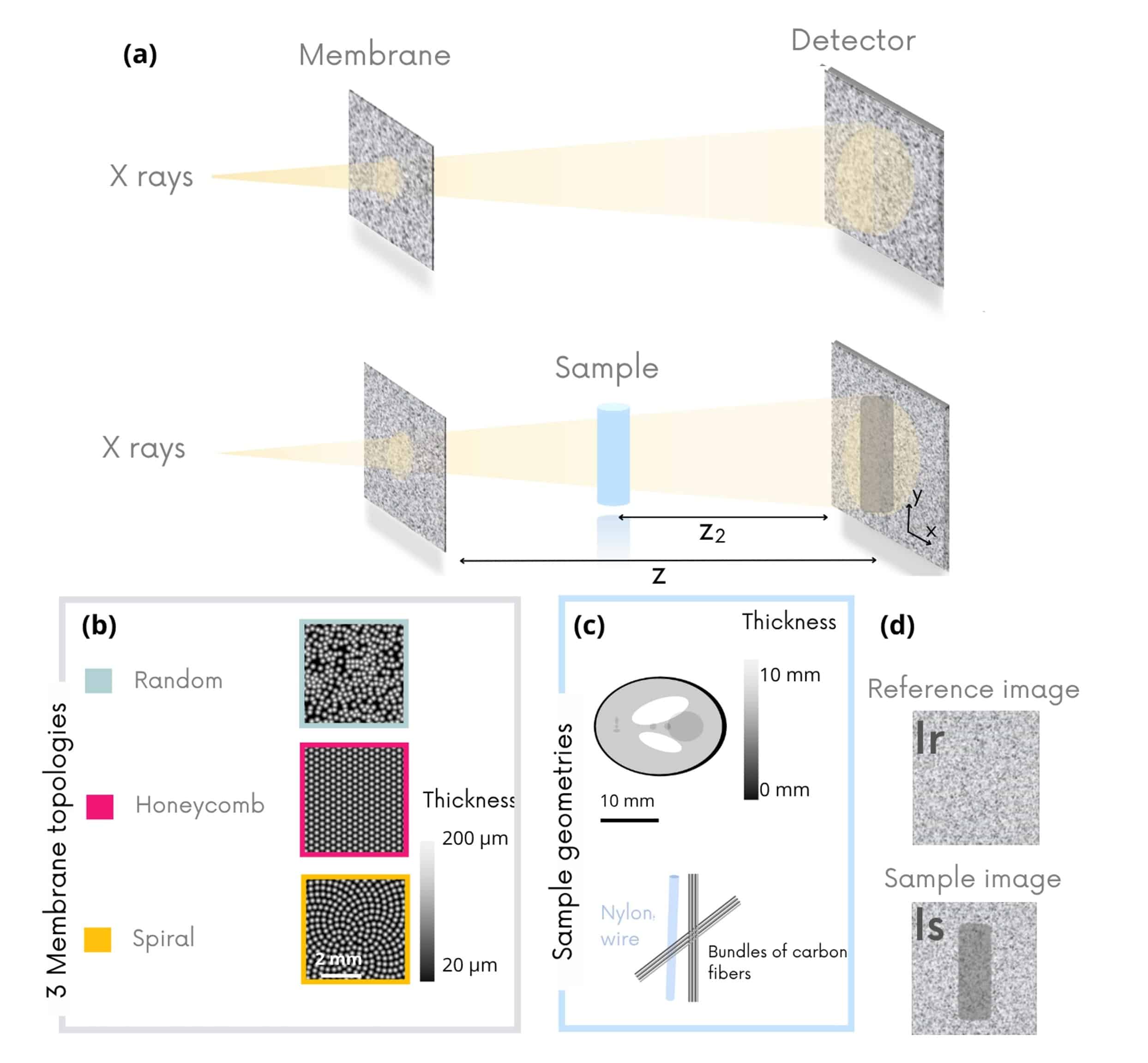
Figure 1. (a, d) Modulation Based imaging (MoBI) method consists in inserting a single mask into the X-ray beam to locally modulate the intensity on the detector. Several pairs of images are acquired of the mask alone (Ir) and of the mask with the sample (Is) by shifting the mask position between each acquisition pair. b) Three different modulation topologies (c) and two types of samples have been compared in this application note.
References:
[1] S. Berujon, H. Wang, and K. Sawhney. X-ray multimodal imaging using a random-phase object. Physical Review A 86, 063813 (2012). DOI: 10.1103/PhysRevA.86.063813
[2] V. Di Trapani, S. Savatović, F. De Marco, G. Lautizi, M. Margini, and P. Thibault. Speckle-based imaging (SBI) applications with spectral photon counting detectors at the newly established OPTIMATO (OPTimal IMAging and TOmography) laboratory. Journal of Instrumentation 19, C01018 (2024). DOI: 10.1088/1748-0221/19/01/C01018
[3] M.-C. Zdora, P. Thibault, T. Zhou, F.-J. Koch, J. Romell, S. Sala, A. Last, C. Rau, and I. Zanette. X-ray phase-contrast imaging and metrology through unified modulated pattern analysis. Physical Review Letters 118, 203903 (2017). DOI: 10.1103/PhysRevLett.118.203903
[4] H.-H. Wen, E.-E. Bennett, R. Kopace, A.-F. Stein, and V. Pai. Single-shot x-ray differential phase-contrast and diffraction imaging using two-dimensional transmission gratings. Optics Letters 35, 1932–1934 (2010). DOI: 10.1364/OL.35.001932
[5] Y.-Y. How, D.-M. Paganin, and K.-S. Morgan. On the quantification of sample microstructure using single-exposure x-ray dark-field imaging via a single-grid setup. Scientific Reports 13, 11001 (2023). DOI: 10.1038/s41598-023-38199-z
[6] L. Guitard, A. Stolidi, G. Giakoumakis, R. Sousa Martins, J. Primot, and A. Jarnac. Robust quantitative X-ray phase diagnostic for carbon composite characterisation in the context of lightning induced risk. Scientific Reports 14, 21803 (2024). DOI: 10.1038/s41598-024-72087-7
[7] M.-K. Croughan, Y.-Y. How, A. Pennings, and K.-S. Morgan. Directional dark-field retrieval with single-grid x-ray imaging. Optics Express 31, 11578–11597 (2023). DOI: 10.1364/OE.480031
[8] C. Magnin, L. Quenot, D.-M. Cenda, B. Lantz, B. Faure, and E. Brun. On the optimisation of the geometric pattern for structured illumination based X-ray phase contrast and dark field imaging: A simulation study and its experimental validation. (2024). DOI: 10.48550/arXiv.2504.10665